 The Emotion Link
The Ultimate Exercise · Twenty Years in the Making
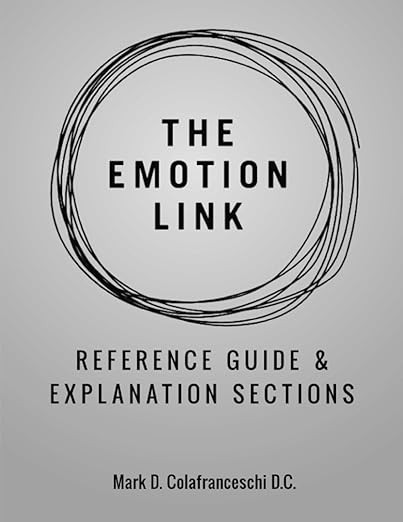
The Emotion Link Reference Guide.
Every symptom in this library points to the same doorway: a practice for meeting the buried feelings beneath the body's signals. The Guide is the full method — the one I refined over twenty years — paired with a reference you can return to for any condition.
This guide is written for people who are ready to do the Ultimate Exercise. Identifying the feeling is the beginning — the exercise is the deeper work of meeting it.
Reserve your copy
The full practice, in your hands.
A printable, searchable companion to every section of the library — with the Ultimate Exercise woven through. Step-by-step prompts, belief releases, and the somatic sequence I use with clients.
Exercise · The Premise
Why your condition keeps coming back.
The Emotion Link is the main reason your condition keeps coming back — or fails to resolve.
Why diet and exercise alone rarely hold
Your buried emotions and changeable personality traits are what dictate your lifestyle. Changing your diet or exercising is almost always short-lived if the feelings underneath are not addressed. Diet and exercise absolutely create health or illness — but the emotions and personality behind those choices are upstream of both.
This course doesn't tell you what to eat or how to train. It helps you dissolve the emotional blocks that quietly interfere with the healthy, common-sense, virtuous choices you already know how to make.
Buried emotions cause illness — and releasing them allows healing
The body stores what the mind won't process, and chronic storage becomes chronic symptom. Most people accept the first half of that sentence and quietly reject the second: that meeting those buried emotions is what allows the body to let the symptom go.
The first instinct is usually to bypass the stress that caused the anxiety, the weight gain, the pain — and reach for a pill, a protocol, or a diet that promises relief. Most practitioners, holistic and medical alike, are trained to treat symptoms rather than the emotional root. That isn't malice; it's the model they were taught. And because a small percentage of those treatments do bring short-term relief, the deeper cause stays hidden. Addressing the buried emotion is what creates lasting change.
It isn't genetics, and it isn't bad luck
Most people get stuck here. They've been told their condition is genetic or simply unlucky. In truth, only about five to ten percent of conditions are primarily genetic1. Anxiety, depression, heart conditions, weight, chronic pain, and over ninety percent of cancers are not. The evidence increasingly supports an emotional and lifestyle origin — a full explanation follows in this course.
Every organ carries an emotional signature
Each organ, limb, and system has a purpose — some obvious, like eyes and ears; some less so, like the kidneys or the skin. The Emotion Link connects each one to a feeling the body has been holding on its behalf:
- Ears — what we don't want to hear
- Back — feeling unsupported, or wanting to back out
- Stomach — worry we can't put down
- Skin — boundaries crossed or unspoken
- Kidneys — old, unexamined fear
These connections are evolutionary. They go back thousands of years.
The missing piece: a practice, not just a map
Many systems have mapped the emotional link — Louise Hay, Karol Truman, traditional Chinese medicine, and German New Medicine among them. They show which emotions correspond to which organs and conditions. What they do not provide is an exercise for dealing with and processing those buried feelings once they are found.
That is what this work offers. The Ultimate Exercise is the missing piece — a guided, repeatable practice for meeting, feeling, and releasing the emotion beneath the symptom. It is taught and refined by Dr. Mark Colafranceschi, who developed it through two decades of clinical practice. The map tells you where to look; the exercise gives you the tools to do something about it.
Case in point: ulcers and worry
In the 1980s, medicine publicly connected stomach ulcers to the emotion of worry. The awareness spread, the cultural permission to admit worry grew — and the incidence of ulcers fell sharply. When the subconscious feeling was brought into consciousness, the stomach no longer needed to hold it.
That is the entire premise of this work, demonstrated in a single condition. The Emotion Link is the rest of that map.
In the next section, you'll begin identifying your own Emotion Links.
Locate the buried feeling
Use the library to translate a symptom into the emotion, belief, and unspoken truth underneath.
Run the Ultimate Exercise
A repeatable somatic-emotional sequence — the one I refined over two decades of practice.
Re-pattern the belief
Replace the buried belief with a felt, embodied truth so the symptom no longer needs to speak.